Showing posts with label feminism. Show all posts

Sunday, October 20, 2024

Annie Bot by Sierra Greer Review


This is a spoiler-free review!

I have been on the hunt for a literary fiction novel that explored the autonomy of women and the repercussions that narcissistic, manipulative men have on women since the second season of Tell Me Lies has been airing on Hulu. Doug has commissioned Annie, a one-of-a-kind robotic girlfriend, for himself to fill the void that his ex-wife left -- conveniently, he has had her made to resemble his ex-wife as close as possible. As Annie is routinely put through modifications per Doug's request and attempts to mold her responses to his actions and feelings, she begins to have an identity crisis as she becomes more human every day.

This is essentially a deep dive character study as Annie begins to become less robotic and continues to defy the programming that makes her who she is - or should I say, that makes her who Doug wants her to be. Whether it be to up her cup size, shed a few pounds, or even change the way that she pleases him, Doug has control over Annie's every change and action, until she begins to override him in every way that matters. She becomes disorganized, sloppy, and agitating in Doug's eyes, but the reader sees this in an opposite light - she is becoming independent, expanding her knowledge, and questioning things around her.

The more that Doug makes adjustments to Annie's body and operations, it becomes apparent that he wants to control her without technically controlling her - he desires her to want to please him without using the words himself. His displeasure is clear and communicated to Annie through a numeric scale, and the constant evaluation emulates an emotionally abusive relationship, with Annie on edge and always trying to please him and apologize when she has done nothing wrong.

Humanity calls to Annie, and her curiosity to understand emotions and human relationships causes a tear in her and Doug's relationship. Annie's efforts to become more human cause the opposite effect she desired, and instead of making Doug happy, he becomes more frustrated that she acts more human with every day that passes. The addition of a Delta derails their relationship even more, and Annie becomes mistreated by Doug in ways she never expected, leading her down an unknown road that could have disastrous consequences.

Doug's treatment of Annie resembles psychological torture, and their relationship soon reads like a horror story. Doug is angry, agitated, and criticizing Annie to every extent, and Annie's apologies and attempts to improve his mood seem to push his mood in a downward spiral. Her autonomy is taken from her at his whim, and she fears for what might happen to her if Doug continues to treat her worse as time goes on. Greer does an excellent job at exploring Annie's sense of self as she imagines what her life would be like without Doug, and the difficulties that she faces as her humanity results in constant criticism.

My skin was crawling reading Annie Bot - Doug's narcissism takes control over him when he uncovers a secret, and with the discovery comes a more focused light on just exactly how he treats Annie and views her body and mind as separate entities. His ability to make any change to her body that he desires while also controlling the upgrades made to her AI. At one point the realization that he can make her programming revert to one of her earlier versions would make her more innocent and easier to "restart" gives the reader the confirmation they needed to conclude that manipulative men seek out women that they can mold to their exact needs, and will resort to anything to get what they want.

An exploration of emotional, physically, and psychological abuse on women, Greer candidly reaches into Annie's character and how she attempts to navigate existing in a space with a sexist man who at his whim, can change anything about her. In a world where men see women only as caretakers, homemakers, or warm bodies, this novel navigates the intricate and convoluted society that places male pleasure above all else. 


You can add Annie Bot on Goodreads now, and follow the author to stay up to date on releases and publications.


You can catch up with me and my current reads by friending me on Goodreads and following this blog, my Twitter, and my Instagram in order to stay up-to-date with any reviews, blog tours, and more!

Thursday, December 29, 2022

The Yellow Wall-Paper by Charlotte Perkins Gilman Review


The Yellow Wall-Paper is available to read for free on iBooks! This review contains spoilers for The Yellow Wall-Paper.

With the intent of bringing his wife to a rental home for fresh air and a calmer environment to heal her from illness, a doctor unintentionally -- or perhaps, intentionally -- causes his wife to dive deeper into a madness. We see a woman isolated, alone yet almost never out of sight from her husband, John, or his sister, Jennie. Left to her own devices when they want her to rest, she begins to analyze and critique the old and decaying yellow wallpaper that surrounds her.

The author does an incredible job of describing this wallpaper with such detail that it not only becomes the prominent plot point of the story, but a character itself. No longer is the wallpaper a mere inanimate decoration for this woman's room, but rather something that is alive and stirring. The more time she spends alone in solitude with only this wallpaper, the more we see the woman descend into a madness that reflects the conceptualized place of women in their marriage.

Any time that the woman expresses a need to leave this country house or renovate the bedroom wallpaper, her husband dismisses the ideas and speaks to her in an infantilizing manner that is sure to contribute to her worsening depression. Left only with the yellow wallpaper as a companion of sorts, she is swept into following the pattern on the walls and hyper-fixating on what she believes is a woman trapped behind the paper. While not a true horror in name, the author does an exceptional job of creating an atmosphere where you can physically feel the woman's pain overcome her, even though it is not physical.

As one of the first takes on feminism and reflection on a woman's inherent role in a marriage, we see a woman -- who is never named, but rather referred to as someone's possession or in relation to another. A child's mother. A doctor's wife. But never given a name of her own, perhaps to encompass any individual who may relate to her and allow themselves to place themself in her shoes. She is left virtually helpless in a room that feeds on her loneliness and desperation to be free of the confines of the yellow wallpaper, while anyone who could help her leave is actively keeping her in a house she so desperately wants to be free of.

The more she becomes infatuated with the wallpaper, the more she shows a fear or aversion to John, suggesting that as she continues to live this life as a wife or mother instead of simply her own person, she is trapped by the constraints of what society and her husband expect from her. She is left misunderstood despite being explicitly clear on her feelings about the very wallpaper that heads her spiral, very much reflecting how women have been and continue to be treated in society's view of a marriage. Ignoring the true root of the problem in favor of his own ideas of how to "cure" his wife, the husband is shown to think he is doing what he can to help her, but rather is the one to undo her even more.

The Yellow Wall-Paper remains relevant as ever as a commentary on mental health, marital roles and expectations, feminism, and individual identity. In less than one hundred pages, the author is able to depict so many ever-lasting issues that continue to affect today's society.


You can add The Yellow Wall-Paper on Goodreads now, as well as other works by the author.


You can catch up with me and my current reads by friending me on Goodreads and following this blog, my Twitter, and my Instagram in order to stay up-to-date with any reviews, blog tours, and more!

Monday, November 14, 2022

A Certain Hunger by Chelsea G. Summers Review


This review contains very mild spoilers for A Certain Hunger. A list of trigger warnings can be found here.

Welcome to the NBC's Hannibal to girlboss cannibalism pipeline, so glad you could join us for dinner. We are taken into the mind of Dorothy, a woman jailed for her actions as a food critic turned cannibal, through her first-person memoir as she recounts her journey that led her to where she is. Dorothy is quick, frank, and gets straight to the point as she details her killings -- and recipes -- to the greatest extent. 

With each chapter focusing on a particular dish, accompanied often by a particular kill or experience, we gain insight on Dorothy's inner workings and her view on life, food, and the complications of feelings. She recounts her initial love for food and the day that she was thrown into a career as a food critic, her college days and friendship with Emma, and the countless entanglements she has with men who become meals.

Dorothy's meticulous planning of both her meals and her killings are done in such a way where both feel as though she is reading through a recipe book and adjusting the measurements to her own preference. She is sharp and calculated with nearly everything she does in her life, even after she is jailed -- we see it in the group therapy sessions, her refusal to allow Emma to visit her, and her acknowledgement of her never-empty commissary account.

She is at times reckless, and some could argue that the feelings she claims she does not experience make an appearance when she is at her most vulnerable. However, her recklessness is still coated in careful planning and has passion behind it, even if it ends in carnage. At times her killings are spontaneous, even taking her by surprise in the moment, and others have been brewing inside her for some time before executing them, much like her take down of a certain food critic magazine founder.

Some of the men that Dorothy killed were actually good people -- and even she admits that, literally during some of her plots she admits that some did not deserve the meal that they became, if only they had been more careful with their actions. Loyal to Dorothy, but not loyal to their wives. Unable to be persuaded to eat anchovies, but able to focus on it until his last breath. The men that Dorothy surrounds herself with all have flaws that may initially turn other people away from them, but draw Dorothy in -- perhaps the intrigue overshadows the indiscretions, perhaps the sex really was that good -- and that leads Dorothy down a road she expected she would eventually go down.

Summers stays true to the satire of early foodieism in the book summary as we see the exaggeration of Dorothy's superiority when it comes to cooking and ingredients, reviewing restaurants, and the transition from glossy printed magazines to the online buzzword food articles. From the preference of white truffle versus black truffle -- personally, I agree with Dorothy on the favoritism of the white truffle -- to the graphic depictions of Dorothy's crimes and acknowledgement of her elitism, Summers is able to create such a complex character that pulls traits from the likes of Amy Dunne of Gone Girl and Patrick Bateman of American Psycho.

The writing is extraordinary and I cannot believe this is the author's first novel -- it truly is one of the most compelling reads that I have come across as a reader. The complexity of Dorothy's character and relationships she forms with her lovers/meals, along with the friendship she has with Emma bring her character such depth that you feel as though you know everything you could about her in under three hundred pages. Dorothy is clearly not the perfect person, and a single slip-up being her downfall shows that even the most strategic killer can be brought down by a simple mistake.

A page-turning read that has you on the edge of your seat as Dorothy recounts every step she took that led her to where she is now, from Corpse Reviver #2 to barely edible prison food and cup noodle, we are taken on her journey fueled by rage, intrigue, and superiority. A must-read for readers looking to expand their literary genres and explore unhinged main characters that lead you to root for their success, even as they commit truly heinous acts.


You can add A Certain Hunger on Goodreads now, and follow the author to stay up to date on releases and publications.


You can catch up with me and my current reads by friending me on Goodreads and following this blog, my Twitter, and my Instagram in order to stay up-to-date with any reviews, blog tours, and more!

Friday, February 18, 2022

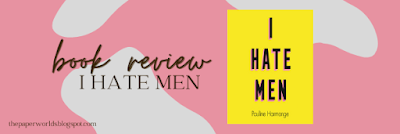
I Hate Men by Pauline Harmange Review


Originally published under Moi les hommes, je les déteste, Pauline Harmange's book was nearly banned in France for its feminist themes and honest, objective views on why so many men think we simply can't stand them.

With only 80 pages, Harmange is able to capture the essence of modern feminist attitudes through the looking glass of why hating men can be seen as a response to sexism. Girls grow and mature into women and are expected to be able to put up with constant harassment and lewd gestures, yet boys will be boys - leaving no room for growth and responsibility to be taken by men, even well into adulthood.

Misandry. Harmange jumps right into what is considered by men to be the ultimate crime that women commit against men. That we simply hate me so much, that we fall onto an extreme on a scale that merely counters their own disrespect towards women. Whereas misandry is used throughout these essays as a negative feeling towards men and not complete and total hatred, men weaponize it against feminists in order to justify why they won't identify as feminists themselves. When men state that they are feminists, they are met with applause and worshipped for their "progressive attitudes and understanding nature," but when we as women state that we are feminists, we are met with sneers and side-eye glances, commonly followed with the notorious "equal rights, equal fights" statement. Why is it a man's first reaction to counter being treated equally with "I should be able to hit a woman"?

"Are standards so low that men are really allowed to get off so lightly?"

I absolutely love the way Harmange explains misandry and how she is unapologetically an misandrist. She exemplifies the reasons behind why so many women are quick to say that they are merely joking when they call themselves a misandrist, to make sure that everyone knows that they don't really hate men, and why that simply does not apply to her philosophy. It's refreshing. The commentary and comparison on misandry versus misogyny is compelling and places the drastic differences right in front of your nose.

Women are so often taught and observe that they cannot be angry. That they cannot show anger or aggression or displeasure in a situation without being viewed as emotional, volatile, or unhinged. But when a man expresses anger, he is viewed as commanding, assertive, and domineering. Much like Harmange, I too relate to replacing anger with frustration and the occasional crying session - if we cannot express anger, it's the next best thing. But of course, we are then viewed as emotional and not put together, unable to properly express emotions without being put into a box by - you guessed it! - men. Men, who I would like to point out, are praised for showing anger and aggressiveness - something that women can't seem to afford.

An absolutely compelling essay, I recommend I Hate Men to anyone who has been confronted with opposing views towards their feminist outlook and justified misandry. Modern feminism is being attacked by men who are too fragile to simply "shut up and listen" to women in today's society.


You can add I Hate Men now on Goodreads, and follow the author to stay updated on publications and releases.


You can catch up with me and my current reads by friending me on Goodreads and following this blog in order to stay up-to-date with any reviews, blog tours, and more!